


Alumni Interviews
[Vol.02] Atomu Yamaguchi
Background
Graduated from Tokyo Metropolitan Sogo Geijutsu (Comprehensive Arts) High School, Department of Fine Arts, Nihonga (Japanese-style painting) major
Now 19, studying at Bunka Fashion College
2022: Soen Award, Honorable Mention (1st place)
At GAJYUKU: from 5th grade of elementary school (May 2012) until finishing junior high (March 2017) — almost 5 years
— We spoke with Atomu Yamaguchi, who attended GAJYUKU through junior high.
It’s full of things you’d never hear in class, and a candid look at one of our alumni.
Atomu now studies fashion and design at Bunka Fashion College, while also teaching younger students as an assistant at GAJYUKU. We asked him about his time at GAJYUKU and his hopes for the future.
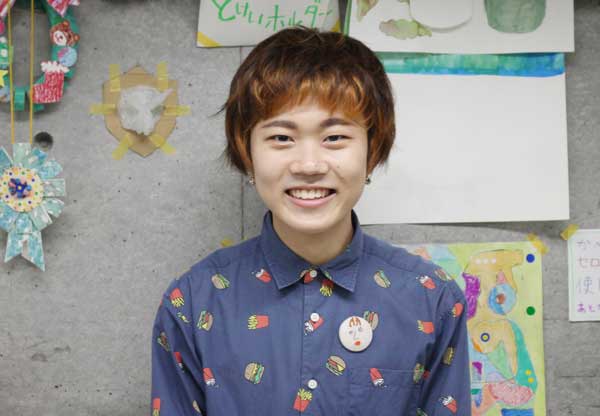
When I was at GAJYUKU
Q Please tell us about your memories of GAJYUKU, or anything that left an impression.
A When I was a student, it never felt like “do this”; I felt I was allowed to draw the way I wanted, and I loved that freedom.
Though I’m not quite sure whether that’s OK at GAJYUKU now… (sweat)
(Atomu now also works at GAJYUKU as an assistant teacher, so perhaps there are things he notices now from the teacher’s side.)
I drew plaster casts too. I did nothing but drawing, really.
There were lots of stuffed animals, and sometimes they were swapped between studios, so there were plenty of motifs that made you want to draw. Lots of artworks on display, too.
GAJYUKU classes are small, but in that small space I got to see all sorts of things. I could see lots of interesting work by other students and keep track of what everyone was doing, which helped with my own drawing.
What I remember from the lessons is, of course, the very first one: Color Water with the 3 primary colors.
For little kids, being taught to learn from color — that you mix colors to make colors — is really useful for drawing later on.
If you’re going to draw, you have to do that to some extent anyway.
I think I also experienced at GAJYUKU things like “you can draw with all sorts of tools” and “it’s fine to do this part this way.”
As for Gajyuku-ten (the annual exhibition), back then I really, really wanted to go to art university, so I remember looking at the teachers’ works and getting excited: “So if I go to art school, I’ll be able to make works like these.”
I was also happy that my work was in the book.
(Every year GAJYUKU produces an exhibition catalog with the works and photos of their artists.)
I can show it off, too (lol) — “this is what I was like as a kid.”
I think it’s really great that it stays in a tangible form.
Q Is there anything you experienced at GAJYUKU that helps you now?
A Learning that the tools for drawing aren’t just paint, and that the things you can use for crafts aren’t limited to this or that.
Even now, when I draw I don’t just use paint — I pile on all kinds of stuff — and I think that’s strongly influenced by GAJYUKU.
I clearly remember there being beads and things at GAJYUKU, and with my recent work too — it’s not exactly a craft, but I remember that everyone at GAJYUKU used lots of things like that.
— He also told us about winning a prize in Hachioji City’s book-report painting competition.
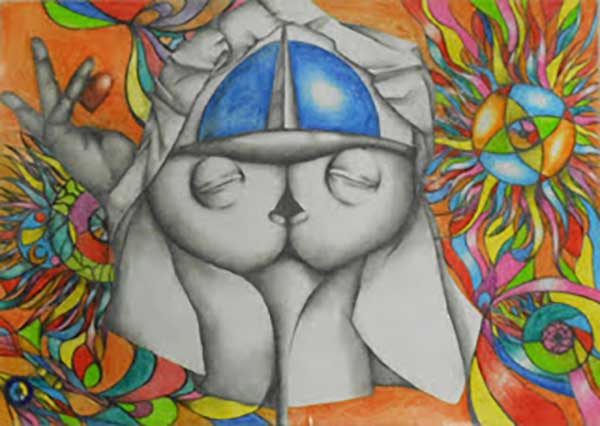
Book-report painting competition, 2015
It’s thanks to GAJYUKU that I came to draw this well and to have ideas like this — that feeling of “it’s fine to just draw it.”
The particular atmosphere of my paintings was also nurtured at GAJYUKU. I think they’re the kind of paintings that turn the air around the viewer into the air of the painting.
Q Why do you say it’s thanks to GAJYUKU that you could make paintings with that atmosphere (that world of their own)?
A Why, I wonder? I don’t really know myself.
This is a painting you couldn’t make just by going to school.
At school it feels like you have to study drawing — like “memorizing.” Drawing for entrance exams is also like “memorizing.”
This kind of painting is — I’m not sure this is the right word… closer to an idea sketch….
— Afterwards it struck me that this is a work of “expression,” a world he imagined himself. We’d be happy if GAJYUKU helped even a little.
Looking at works from his GAJYUKU days
Q Is there a work that left a strong impression on you?
A Of all my works from back then, the most memorable is the one that won the Director’s Prize at Gajyuku-ten.
My mom still has it on display at home. I still like it myself.
When I was drawing the trees in the background, the teacher said, “Trees look like this, don’t they? How could you draw them? How about trying it like this?”
And — wow! I could draw trees. Being able to do it gave me confidence.
For the background, too, it wasn’t about a specific place; I drew in the cloth and the trees thinking about what would be good to have there as part of the picture’s composition.
This painting was where I first discovered “blending.” I remember it so clearly!
“Whoa! If you rub it with your finger, it goes all soft like this!”
That’s the biggest thing I gained from what I learned at GAJYUKU.
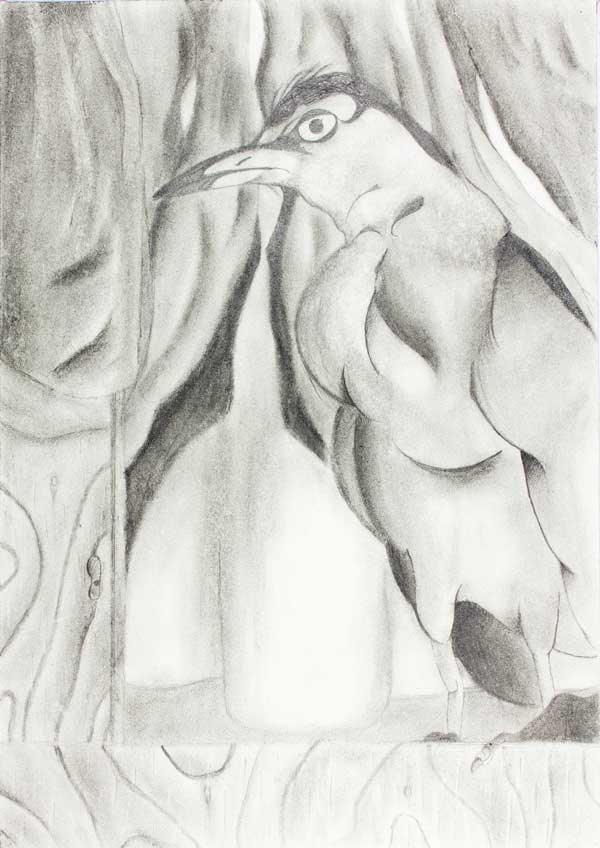 “Dangerous Eyes” / pencil drawing / painting that won the Director’s Prize in 2013
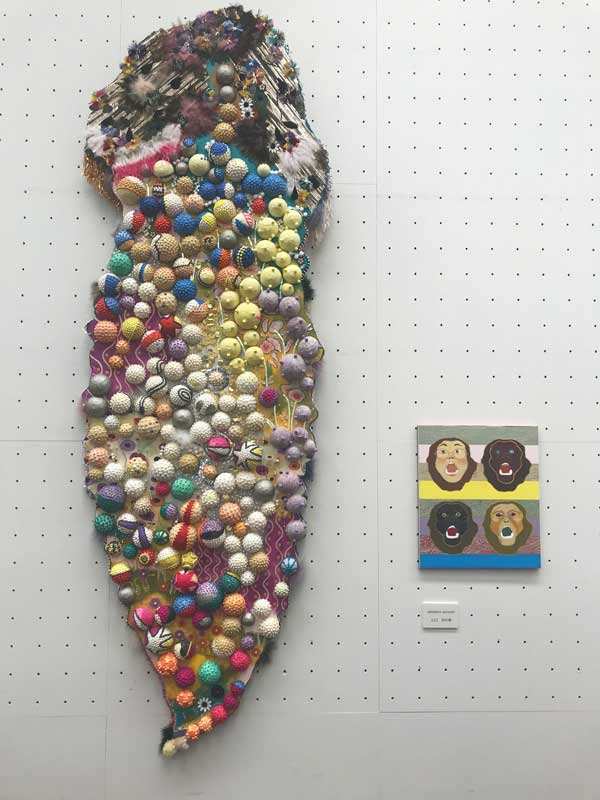 Sogo Geijutsu High School — graduation work
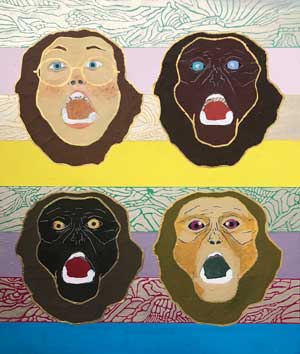
Making work, and dreams for the future
Q What do you value when you make a work?
A Using lots of color matters. I love sparkly things. I love glitter.
I also like things that pop out, and using different materials — I just stick things on.
I feel realistic paintings stop there. Right now I want to make things only I can make.
Like, nobody else makes things this bumpy, right?…
I hate doing the same as everyone else. I think about how not to fall into trendy, mainstream thinking.
If everyone dresses their figure in clothes, I’ll pick a muscly guy in swim trunks. If others make children’s clothes cute in pastel colors, I’ll make grown-up-looking children’s clothes.
The other day at my school we had a shirt/blouse assignment, and this is what I handed in.
— He showed us a picture of a shirt-blouse he made, with a dragon painted on the back.
He painted the dragon on denim and sewed it onto the shirt-blouse.
The shirt-blouse fabric wasn’t suited to painting on directly, so he deliberately painted on denim first and then sewed it on.
We felt we caught a glimpse of the origins of Atomu’s design there.
I felt it would be wrong to throw away the drawing experience I’d built up. I thought I had to use it to make clothes, so I painted it.
How can I use painting in clothing? I researched it a lot myself. I found the best fabric paint, and studied methods too — like what works best on this kind of fabric.
— From there, the conversation moved on to the direction of his design.
Technology has advanced so much now that all sorts of designs can be done fairly easily by machine.
With designs everyone might think of, you can’t survive (in the design world). Without new ideas, you die. How can I make my ideas something no one else could come up with? Sometimes that backfires and my teachers at school shoot it down, though (lol)
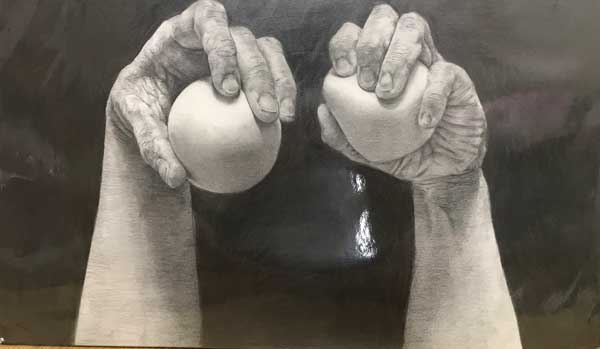
Hand drawing
Plaster cast drawing
Q Please tell us your dream for the future.
A I want to be a designer.
Famous brands have unshakable patterns and atmospheres (worlds).
I think I absolutely have to create that too, or I won’t survive.
If that world gets vague, it disappears.
A world where I can take all the good points and thrive. I want to become so famous that fakes of my brand appear.
A brand with a world all its own, which people who love that world keep buying. It doesn’t change that world to follow trends. No ups and downs. I’d love to become something like that.
Right now I’m in the middle of building my own world.
Some of my seniors already have theirs.
You need confidence — not to be swept along, to say “this is how we do it.”
The world of fashion design is fiercely competitive.
Brands appear and vanish, and even those called famous brands can face crises.
That’s the world I’m heading into… (heart pounding)
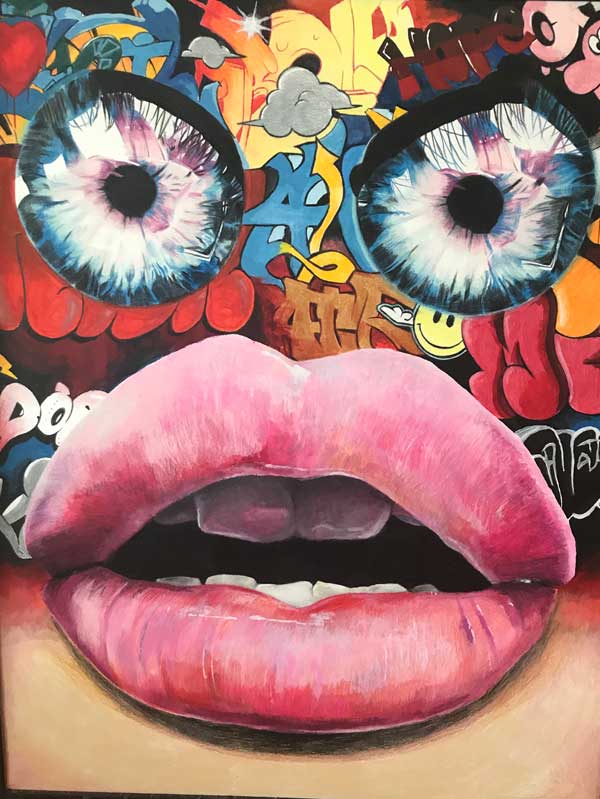
— But hearing all this, something clicked for us.
We felt Atomu has already found his own arena — found what he needs to do.
We’re delighted that it’s a world of makers.
Drawing pictures and making crafts can be the way into the world of art. Atomu is one of those people. And the world of art is vast. Within that vast world, he is finding what he should do. We felt that a student who used to come to GAJYUKU has become someone we respect as an adult.
Thank you so much for sharing your story with us.

 Go to Alumni Interview vol.3