


Alumni Interviews
[Vol.01] Kana Inoue
Background
Graduated from Tokyo Metropolitan Sogo Geijutsu (Comprehensive Arts) High School, Department of Fine Arts, Nihonga (Japanese-style painting) major
Now 20, studying at the Kawaijuku Art Institute (a prep school) with the aim of entering Tokyo University of the Arts
At GAJYUKU: from 2nd grade of elementary school (September 2008) until finishing elementary school (March 2013)
— We spoke with Kana Inoue, who attended GAJYUKU through elementary school.
It’s full of things you’d never hear in class, and a candid look at one of our alumni.
Kana now works on drawing and coloring 6 hours a day, and has just held a solo show at a gallery. We asked her about her time at GAJYUKU and her hopes for the future.
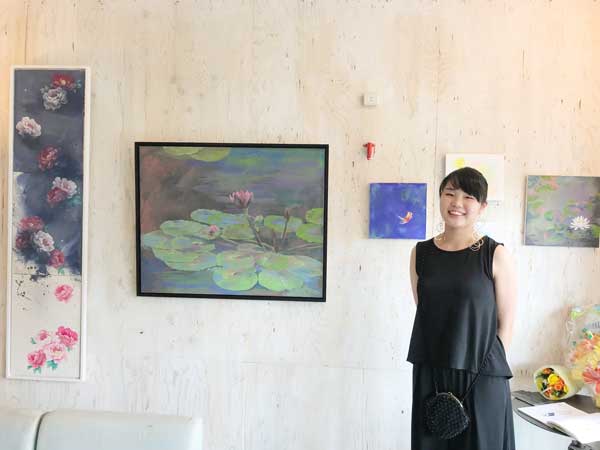
Fun memories of GAJYUKU
Q What was your impression of GAJYUKU Art School for Children?
A I enjoyed “Color Water” (color-mixing practice with colored water in the 3 primaries) and drawing a cow skull with white and black crayons. With Color Water, imagining what color I’d get and then mixing it became my own knowledge, which I found fascinating. I also enjoyed watching kids doing Color Water in their Trial Lessons.
With the cow skull, I remember being thrilled that I could use white and black, which were normally taken away.
Q Is there anything that began at GAJYUKU and led to where you are now?
A My junior high art teacher praised my drawing — I think GAJYUKU was paying off. They recommended a high school specializing in art, so I went to the school festival at Tokyo Metropolitan Sogo Geijutsu High School, saw the exhibitions and the atmosphere, and decided to go there.
In 2010, at a GAJYUKU event at the National Art Center, Tokyo in Roppongi, Mr. Otake (our director) drew a picture in my croquis book, and I still have it on display. I was 10 at the time, and I was amazed at how quickly and easily he drew it. I thought, “So this is what someone who studied art can do.” That was one of the things that set me on the path to art.
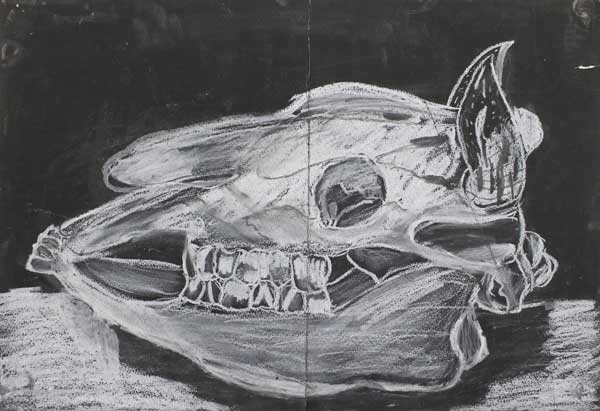 Cow skull drawing (2010, age 10)
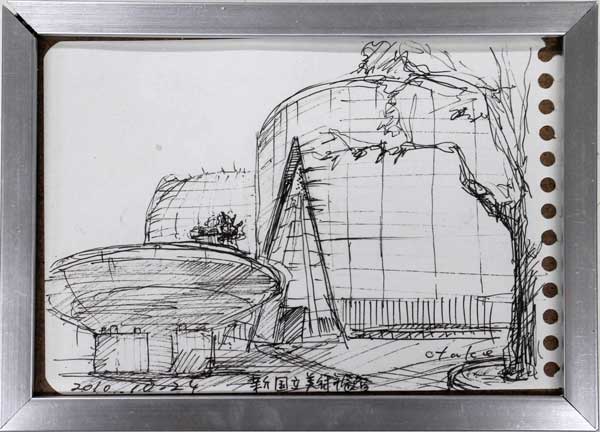 Croquis by our director
Good things about joining GAJYUKU
Q Did you start paying attention to, or become interested in, other things?
A GAJYUKU has teachers from all kinds of fields, so I learned that “art” covers so many different things! Thanks to that, since my high school also had stage art and music departments, I was able to look widely in many directions beyond drawing.
In fact, in a collaborative project class in my 2nd year of high school, working with classmates from other genres turned what had only been images in my imagination into a concrete understanding: “Oh, this is what they’re working hard at.” I felt it would help me in my future work and beyond.
Q Is there anything you learned at GAJYUKU that you’ve built on or still use now?
A On the technical side, I learned not to get lost when mixing colors, and I was trained to notice slight variations even within the same color. When I work, I use 2 watercolor palettes with 100 wells in total, but the usual number of wells wasn’t enough, so I even modified them to add more, smaller compartments.
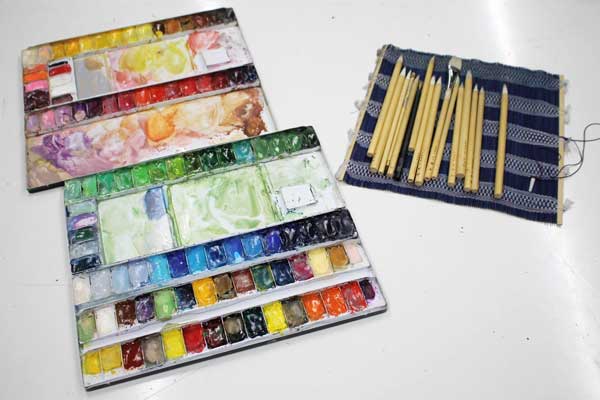 The palette I use now
Recent work
— We asked about the concepts behind works she has made recently (while attending the Kawaijuku art prep school).
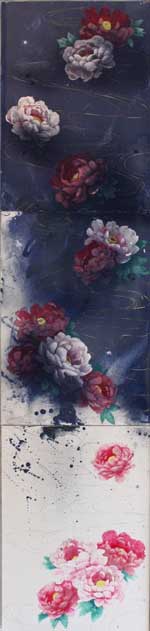
Work: Peony / mineral pigments
After I failed my entrance exam, I thought I wouldn’t be able to do any Nihonga, but one of my prep-school teachers told me, “Go on, paint!”, so I took them up on it.
It started with a trip to a peony garden with high school friends, where I made studies. Since I was retaking the exam, I knew this would be the only painting I could do this year, so I painted it giving it everything I had.
Thanks to this painting, I was lucky enough to be offered a solo show at a gallery.
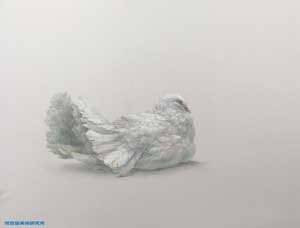 Work: Peacock Pigeon / watercolor
I painted it in 9 hours in total over 2 days. The painting has faded a little in the sun, so the colors may look paler than when it was finished. I was drawn to the fluffiness of the pigeon’s feathers and its cute expression. It was fun to paint, too.
— Her high school graduation work
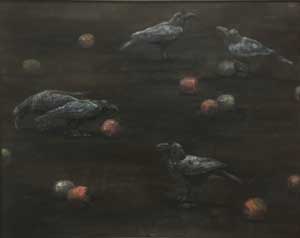 Work: Crow and Apple / F100 / mineral pigments, conté, watercolor pencils, charcoal
Because it was to be shown in a museum, I started thinking about the underdrawing in February and March of my 2nd year, began working on it in earnest at the start of my 3rd year, and painted it for the graduation show in December.
Crows were a big thing for me at the time. Some of the apples are in color and some are black and white, but in fact I painted a colorful ground under the black. When you wash off the black paint, the colors underneath come through, so I drew over that here and there with watercolor pencils.
Looking ahead
Q Finally, please tell us what you’d like to do in the future, or anything you’ve already started.
A This year I had a chance to show my work once, and I’d like to keep exhibiting regularly. There are also other techniques I want to try, and I want to keep taking on new challenges as ideas come to me!
— Thank you so much for sharing your story with us today.